
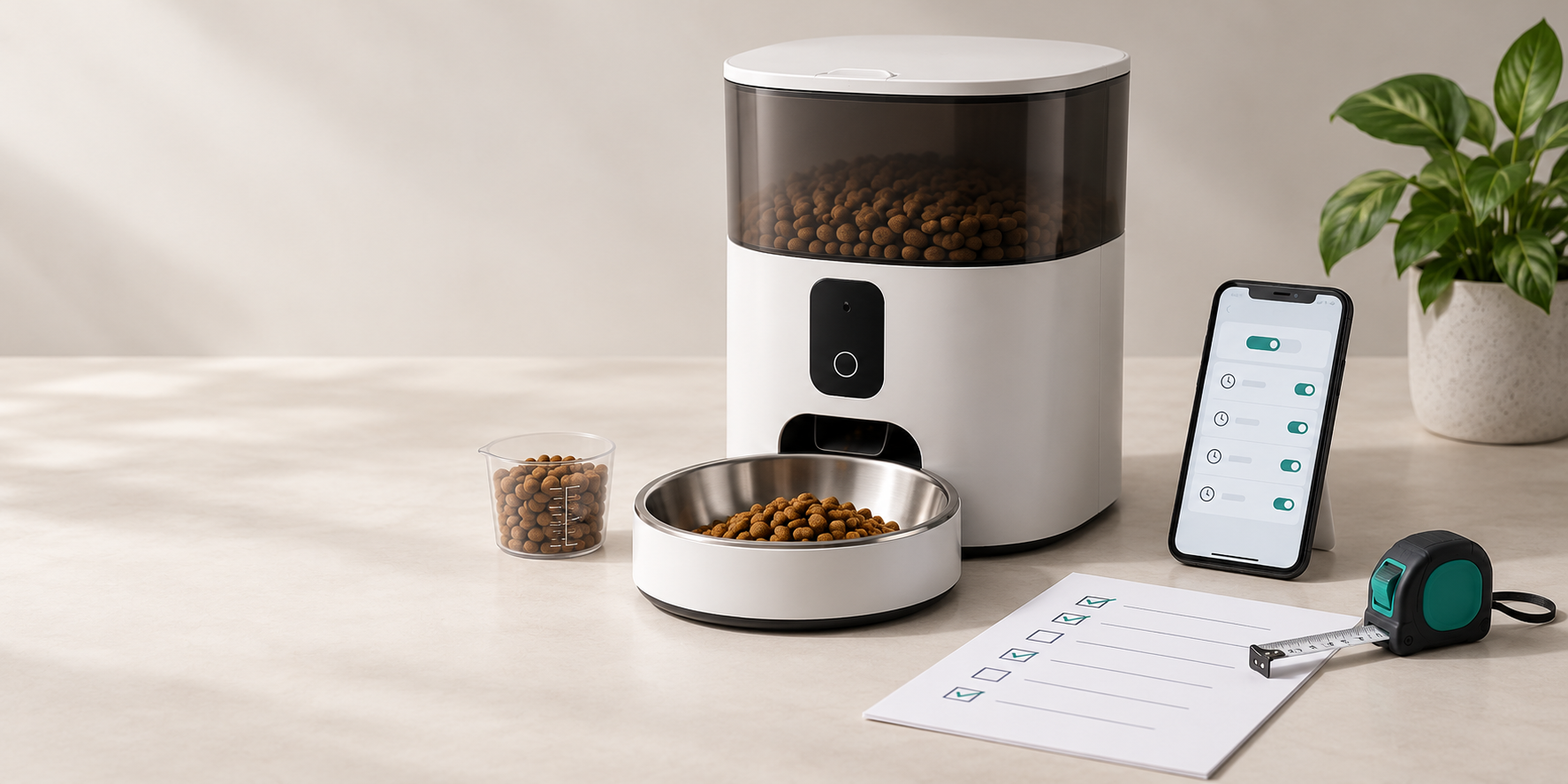
Prepared for: importers, distributors, private-label brands and product teams evaluating an automatic or connected pet feeder.
Last reviewed: October 19, 2026
Document version: 1.0
A smart pet feeder sample should answer a specific sourcing question. It should show whether the selected configuration can dispense the buyer’s intended food, follow the required schedule, recover from power or network interruptions, be cleaned without unnecessary difficulty and fit the target packaging and support plan.
This guide explains ten specifications to confirm before sampling. It also compares information currently published for four PetCrown feeder models. Published product-page data is a starting point, not a final production specification. Buyers should request a dated specification sheet for the exact model, hardware revision, firmware, App arrangement, accessories and destination market before approving a sample or order.
Smart pet feeder sourcing checklist at a glance
| Specification | What to confirm | Why it affects the project |
|---|---|---|
| 1. Capacity | Usable food volume, compartment layout and refill point | Capacity labels alone do not define feeding duration or food compatibility |
| 2. Food compatibility | Dry-food type, particle range, shape, oil level and breakage risk | The same mechanism may perform differently with different foods |
| 3. Portion control | Grams per portion, tolerance, maximum portions and schedule limits | App settings must be translated into measurable output |
| 4. Power | Adapter rating, plug, cable and backup-battery behavior | Power configuration affects market readiness and interruption tests |
| 5. Connectivity | Wi-Fi bands, setup flow, offline behavior and account arrangement | Connected features depend on the exact module, firmware and App |
| 6. Camera and audio | Whether included, resolution, recording, storage and privacy questions | Optional versions can look similar but have a different cost and review scope |
| 7. Cleaning | Food-contact materials and removable, washable components | Maintenance affects repeat use, instructions and spare-part planning |
| 8. Size and stability | Product footprint, bowl position, anti-tip behavior and pet access | Product dimensions affect use, packaging and freight |
| 9. Packaging | Included accessories, retail box, master carton and artwork | Quotation comparisons fail when included items are different |
| 10. Sample approval | Sample ID, versions, test food, issue list and signed approval record | The approved sample must be reproducible in mass production |
1. Define capacity by use case, not litres alone
Start with the pet type, feeding frequency, expected refill interval and food selected for the target market. A nominal hopper volume does not tell the buyer how many days of feeding it represents. Food density, kibble size, portion settings and the amount that should remain before a low-food warning all affect usable duration.
If a feeder has more than one compartment, document each compartment separately. PetCrown’s XG-WSQ001 page, for example, currently describes a 2 L freeze-dried-food compartment and a 2 L main-food compartment. That configuration should be evaluated as a dual-compartment system, not described only as a combined 4 L hopper.
2. Test the buyer’s actual dry food
Ask for the supported particle-size range and then verify it with the food planned for launch. Size is only one variable: shape, surface oil, crumbs, mixed pieces and moisture can affect bridging, jamming and portion consistency.
Send labelled food samples when possible. For every test, record the product model and revision, food brand or reference, measured particle range, number of cycles, failed or incomplete dispenses and visible damage to the food. If the supplier has not published a food-size range for a candidate model, treat that field as open rather than assuming another model’s range applies.
3. Convert “portions” into measured output
One portion in an App is not automatically a fixed number of grams across different foods. Ask how the portion is generated, the expected tolerance and the maximum schedule and portion settings. Run repeated tests with the intended food and report minimum, maximum and average output.
The current XG-WSQ003 page states a 6 ± 2 g portion reference and describes scheduled feeding with up to 6 doses per session and up to 16 portions per dose. These figures should be checked against the test food and the exact software version supplied for the sample.
4. Confirm normal power and backup behavior
The RFQ should state the destination voltage and plug, adapter rating, cable expectation and whether backup batteries are required. A backup-power claim also needs an operating definition: which functions remain available, whether schedules continue locally, what warning appears and what happens when normal power returns.
The XG-WSQ001 and XG-WSQ003 pages currently identify a 5 V / 1 A supply and four AA batteries as backup. The buyer should still confirm whether batteries are included, the expected operating conditions and which connected functions continue during backup operation.
5. Specify Wi-Fi, App and account requirements
Record the required Wi-Fi bands, onboarding method, number of users, device sharing, language, notification behavior and the commercial arrangement for the App. Ask what happens when the router, internet connection or cloud service is unavailable. A useful sample test includes first-time setup, reconnecting after power loss, changing networks, resetting the device and removing it from an account.
Do not treat one model’s App as a series-wide standard. The current pages name Pet Zero for XG-WSQ001 and XG-WSQ003, while XG-WSQ002 and XG-WSQ004 use the wording “Graffiti” or “Graffiti Smart.” The precise App name, publisher, branding option, service region and account terms therefore need model-specific confirmation.
6. Separate camera, audio and basic versions
A feeder may be offered in basic, Wi-Fi and camera variants. The quotation and sample label should identify the chosen version. For a camera model, confirm resolution, viewing angle, night behavior, microphone and speaker functions, recording or storage method, notification behavior and the data questions that the buyer’s legal or technical team needs answered.
The XG-WSQ003 page currently lists a 2-megapixel camera. The XG-WSQ004 page lists basic, Wi-Fi and camera editions and describes the camera as 2 megapixels. Buyers should not apply the camera specification to the basic or Wi-Fi-only edition.
7. Inspect every food-contact and washable component
Request a component list showing the materials of the hopper, dispensing path and bowl. Identify which parts are removable, which may be washed with water, which should only be wiped and how every part must be dried and reassembled. Check whether the supplied instructions match the sample design.
All four current PetCrown model pages list ABS and 304 stainless steel or SUS304, and their quotation sections list a 304 stainless-steel feeding tray. That does not mean every food-contact component is stainless steel. The component-level material and cleaning method should be confirmed in the dated model documentation.
8. Measure footprint, access and stability
Product dimensions affect shelf space, home placement, retail packaging and shipping. They should be checked on the physical sample, including the bowl and any protruding cable, lid or camera parts. Evaluate access for the intended pet and the stability of the filled and partially filled unit.
A raised or adjustable bowl can be a useful configuration feature, but health or ergonomic claims require appropriate evidence. Procurement documents should describe the physical adjustment and dimensions rather than turning a design feature into an unsupported medical or health statement.
9. Compare packaging and included accessories on the same basis
Ask each supplier to identify the feeder unit, bowl, adapter or charger, cable, batteries, desiccant, manual and retail packaging included in the quoted price. Confirm the plug, manual language, barcode, labels and artwork responsibility.
Published package measurements should be checked against a packed sample before freight planning. A model page can contain translation or data-entry errors; the purchase specification, approved packaging sample and final carton marking should be the controlling records.
10. Approve a traceable sample, not only an appearance
Label each sample with its model, hardware revision, firmware, App version, power configuration, accessories and date. Keep one issue list that records the test, result, owner, required change and closure evidence. If a change affects the mechanism, materials, power, wireless module, firmware, App or packaging, decide whether a new sample or document review is required.
Use the Smart Pet Product RFQ Checklist to send the destination market, quantity, branding, compliance, timeline and after-sales requirements together with the technical sample request.
PetCrown feeder model comparison
Source note: the table below is limited to information visible on PetCrown’s English product pages reviewed on October 19, 2026. “Not stated” means the current page does not provide that field. It does not mean the feature is absent. Request the current model specification and market-availability confirmation before sampling.
| Model | Published capacity | Published food range | Power / connectivity | Camera / version | Published size |
|---|---|---|---|---|---|
| XG-WSQ001 | 2 L freeze-dried food + 2 L main food | Not stated | 5 V / 1 A; four AA backup batteries; Pet Zero App remote feeding | Camera not stated; dual compartments | 178 × 178 × 275 mm |
| XG-WSQ002 | 14 L | Described for large-grain dog food; exact range not stated | Remote App operation; power and Wi-Fi bands not stated | Camera not stated | 430 × 300 × 510 mm |
| XG-WSQ003 | 4 L | 3–15 mm dry food | 5 V / 1 A; four AA batteries; 2.4 GHz + 5 GHz Wi-Fi; Pet Zero App | 2-megapixel camera | 29.5 × 17 × 33 cm |
| XG-WSQ004 | 6 L | 5–15 mm | 2.4 GHz + 5 GHz stated; power rating not stated | Basic, Wi-Fi and 2-megapixel camera editions; optional dual bowls | 24 × 31 × 37.8 cm |
Market-availability note: the current XG-WSQ002 page states that the model is not available for sale in Europe or the United States, and the XG-WSQ004 page states that it is not available in South Africa. Buyers should disclose the destination market in the first enquiry and obtain written confirmation that the quoted model and configuration are available for that market.
Documents to request with the sample quotation
- a dated model and configuration specification;
- dimensioned product and packaging drawings;
- food-size and portion-test conditions;
- adapter, plug and backup-power details;
- wireless module, firmware and App identification;
- food-contact material and cleaning information;
- accessory and spare-parts list;
- available model-specific compliance documents for the destination market;
- sample lead time, sample cost and change limits;
- quotation assumptions, exclusions and validity.
Sample test record
A practical approval record can use the following fields:
- Sample identity: model, serial or sample ID, hardware, firmware and App version.
- Configuration: capacity, bowl, camera, power, plug, color and accessories.
- Test food: reference, particle range, condition and amount loaded.
- Dispensing test: schedule, requested portions, measured grams, repeats and exceptions.
- Interruption test: power loss, backup operation, Wi-Fi loss and reconnection.
- Maintenance test: disassembly, cleaning, drying and reassembly.
- Packaging check: protection, accessories, labels, barcode and manual.
- Issue closure: accepted change, evidence, responsible person and approval date.
Request current feeder specifications
Start with the smart pet feeder category, identify the model and version closest to your project, and send the destination market, test food, sample quantity, power, connectivity, packaging and launch requirements. PetCrown can then review which fields are already defined and which need project-specific confirmation.
Request Current Feeder Specifications
Editorial note: This guide provides general sourcing information. Product features, App services, market availability, compliance documents, prices, minimum quantities and lead times should be confirmed for the exact model, configuration, destination market and document revision.
