
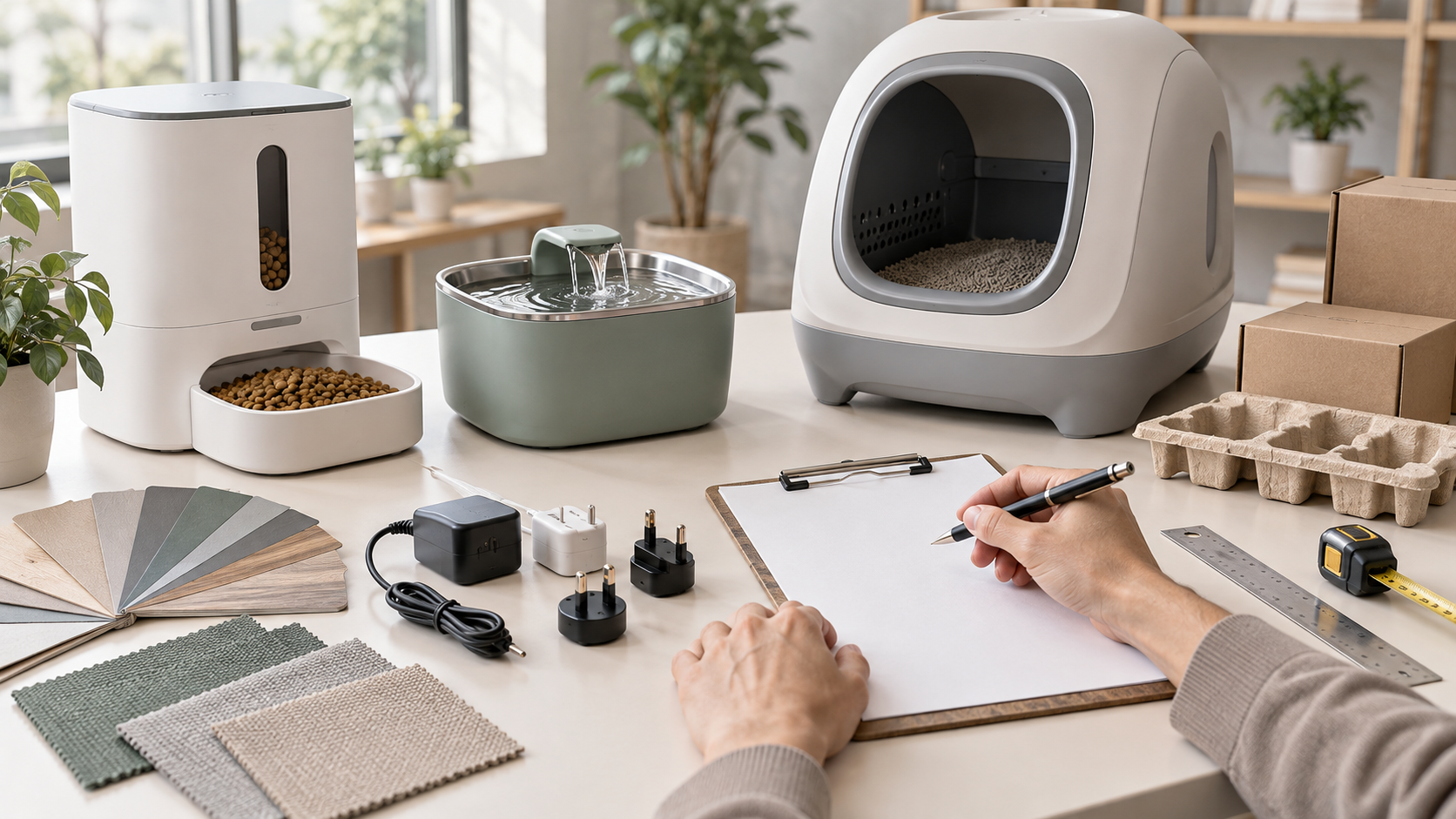
Prepared for: importers, distributors, private-label brands and product teams preparing an OEM or ODM enquiry.
Last reviewed: October 8, 2026
Document version: 1.0
A useful smart pet product RFQ does more than ask for a price. It tells the manufacturer what product is being evaluated, where it will be sold, which configuration is required and how the buyer plans to approve the project. Without that context, two suppliers may quote different assumptions while appearing to offer the same product.
This checklist helps buyers prepare a comparable request for quotation for smart feeders, pet water fountains, automatic litter boxes and related products. It is general procurement guidance, not market-entry or laboratory advice. Product specifications, compliance evidence and commercial terms should always be confirmed for the exact model, revision and destination market.
RFQ information at a glance
| RFQ field | What the buyer should provide | Why the manufacturer needs it |
|---|---|---|
| Destination market | Countries, sales channels and intended launch market | Influences power, labels, manuals, packaging and document scope |
| Product or model | Category, reference model and required functions | Prevents quotations for visually similar but technically different products |
| Quantity | Sample quantity, first order estimate and forecast range | Supports pricing, packaging and production planning |
| Branding and packaging | Logo, color, box, barcode, manual language and artwork needs | Separates standard supply from private-label or structural customization |
| Power and connectivity | Plug, voltage, adapter, battery, Wi-Fi, App and account expectations | Defines the electrical and connected-product configuration |
| Compliance needs | Target standards, reports, declarations, labels and responsible party | Allows model-specific document availability and gaps to be checked |
| Samples and approval | Sample rounds, test focus, approvers and acceptance method | Creates a controlled path from evaluation to mass production |
| Timeline | Target launch, sample deadline, artwork approval and order date | Shows whether development, documents and production can fit the schedule |
| Commercial target | Target price together with configuration, quantity and trade assumptions | Makes cost discussions comparable instead of price-only |
| After-sales support | Warranty route, spare parts, troubleshooting and replacement needs | Defines support responsibilities before the first order |
1. Identify the destination market and sales channel
Start with the countries where the product will be sold. “Europe” or “global market” is usually too broad for an initial quotation. Name the priority countries and indicate whether the product is intended for retail, ecommerce, distribution, subscription, marketplace or another channel.
The sales channel can affect packaging dimensions, barcode placement, manual languages, product claims and the information expected by the buyer’s compliance team. If the first order will cover several markets, separate the requirements for each one instead of treating them as a single configuration.
Include:
- priority country or countries;
- planned sales channel;
- target customer and price position;
- required languages for product, packaging and instructions;
- buyer or importer entity that will review market-entry documents.
2. Name the product category and reference model
Use a current model number whenever possible. If the project begins with a concept rather than an existing model, describe the use case and separate essential functions from optional preferences. A photograph alone is not a specification.
Buyers can begin with PetCrown’s smart pet product catalogue and then review the relevant category:
For each candidate model, ask for a dated specification sheet and record the revision used for the quotation. Do not assume that a feature shown for one model applies to the entire series.
3. Separate sample quantity, first order and forecast
A supplier needs to know whether a number refers to evaluation samples, the first commercial order or a longer-term forecast. Keep these quantities separate. Forecasts can help capacity planning, but they should not be presented as guaranteed orders unless the buyer is making that commitment.
A clear quantity section may state:
- engineering or evaluation samples required;
- number of sample configurations;
- estimated first order quantity;
- expected reorder range and frequency;
- delivery destination and preferred shipping term for quotation.
4. Define branding, color, packaging and manuals
“Private label” can mean a logo on an existing product, or it can involve new colors, packaging, accessories, firmware, App presentation and structural changes. The RFQ should say which level is required.
Provide the logo format, desired logo position, color reference, packaging type, barcode or label requirements, manual languages and any retailer packaging rules. Ask the manufacturer to separate standard options from changes that require new tooling, engineering review, additional testing or a different minimum quantity.
Artwork does not need to be final for the first enquiry. A simple requirement list is enough to identify scope, while final files can follow after the model and commercial basis are agreed.
5. Specify power, App and connectivity requirements
Connected pet products may have several versions that look identical but use different adapters, wireless modules, firmware or App arrangements. The RFQ should identify the expected power and connectivity environment.
Confirm:
- destination voltage, frequency and plug;
- adapter or cable expectations;
- whether battery or backup behavior is required;
- supported Wi-Fi environment and setup flow;
- whether an existing App, branded App or another account arrangement is expected;
- firmware update, reset and connection-support responsibilities;
- privacy or data questions that the buyer’s legal or technical team needs answered.
6. State compliance and documentation needs precisely
Do not ask only whether a product is “certified.” Tell the supplier the destination market, exact configuration and documents your project team expects to review. The supplier can then identify which current reports or declarations match the quoted model and which work remains open.
Ask for model-specific documents and check that the product name, model number, electrical rating, wireless configuration, manufacturer or applicant and revision match the sample under review. Record missing or in-progress items in the project schedule. Final market-entry decisions should be made with qualified compliance professionals or laboratories.
7. Describe the sample and approval plan
A sample request should explain what the buyer intends to evaluate. State the number of rounds, required configuration, testing focus and who will approve the result. This helps the manufacturer prepare a sample that can be identified and repeated.
For every sample round, record:
- model and sample ID;
- hardware, firmware and App version where applicable;
- included accessories and packaging;
- issues found and required changes;
- cost or schedule impact of each accepted change;
- final approval reference before mass production.
The related guide, How to Choose a Smart Pet Product Manufacturer, explains why sample version control, document matching and change closure should be reviewed before commercial terms are finalized.
8. Build a timeline from approval milestones
A target launch date is useful only when the RFQ also shows the decisions that must happen before it. Work backwards from the launch and list the planned dates for model selection, sample delivery, testing, artwork approval, document review, order confirmation and requested shipment.
If the product requires new tooling, firmware changes, a branded App, new packaging or additional testing, ask the supplier to identify which milestones depend on those items. Keep an allowance for buyer feedback and rework instead of treating every first sample as production-ready.
9. Express target cost with its assumptions
A target cost without configuration, quantity or trade assumptions can push the conversation toward an incomplete product comparison. State the target together with the model, included accessories, packaging, branding scope, expected quantity, delivery term and destination.
Ask the supplier to show exclusions and cost drivers. If the current target cannot support the requested configuration, the useful response is a clear alternative: a different feature, accessory, packaging option, quantity basis or product model. The objective is not merely to reach the lowest number, but to compare equivalent offers.
10. Include warranty, spare parts and after-sales support
After-sales planning should be part of the RFQ, especially for products containing pumps, adapters, cables, filters, batteries, sensors or connected functions. Ask which components are replaceable, how they are ordered and what information is required to investigate a reported fault.
Define:
- warranty period and start point;
- fault evidence such as photos, video, serial or batch information and App screenshots;
- replacement, credit or repair responsibilities;
- spare-parts list and replenishment lead time;
- technical contact and escalation path;
- method for reviewing repeated failures and corrective action.
Copy-and-paste smart pet product RFQ template
Buyers can copy the following fields into an email or project brief:
- Company and contact: legal company name, website, contact person and role.
- Destination market: countries, sales channels and planned launch date.
- Product: category, reference model and required functions.
- Quantities: samples, first order estimate and forecast range.
- Branding: logo, color, product marking and artwork status.
- Packaging: retail box, master carton, barcode, labels and manual languages.
- Power and connectivity: plug, voltage, adapter, battery, Wi-Fi and App expectations.
- Compliance: target market, required documents and responsible reviewer.
- Sample approval: number of rounds, test focus, approvers and acceptance record.
- Timeline: sample, artwork, documentation, order and shipment milestones.
- Commercial basis: target cost, trade term, destination and included accessories.
- After-sales: warranty, spare parts, troubleshooting and replacement expectations.
What a comparable supplier response should contain
Ask every shortlisted supplier to return information in the same order. A useful response normally identifies the quoted legal entity, exact model and revision, included configuration, unit-price assumptions, sample terms, lead-time basis, customization boundaries, available documents, open questions and quotation validity.
Keep uncertain items marked as open instead of silently filling gaps with assumptions. When the buyer and supplier use one issue list and one approved sample reference, later changes are easier to track.
Common RFQ problems to avoid
- requesting a price from a product photograph without a model or required functions;
- combining sample quantity, first order and annual forecast into one number;
- using “OEM” without explaining whether the request is logo, packaging, firmware, App or structural customization;
- asking for generic certification claims without a destination market and exact model;
- setting a launch date without sample, artwork and document approval milestones;
- comparing prices that include different accessories, packaging or support scope;
- waiting until after the order to discuss warranty and spare parts.
Send a clearer product brief
A structured RFQ helps both sides identify missing decisions before sampling and makes supplier responses easier to compare. PetCrown buyers can start by selecting a product category or reference model, then send the checklist fields that are already known. Items that remain open can be confirmed during the project review.
Editorial note: This checklist is general procurement information. Product specifications, compliance documents, prices, lead times, minimum quantities and project terms should be confirmed for the exact model, configuration, destination market and document revision.
